Friday, December 20, 2013

2013 in Review, Part II: July-December in Illinois

After a refreshing trip back to Washington at the end of June into the beginning of July (which I'll write about in a forthcoming post), Jen and I made it back to Illinois and moved across campus into a new place. A week long class inaugurated my new job and a season busyness that it is only slowing down now. But don't worry, the birding hasn't slowed down too much.

In my first couple weeks back, I stayed local and filled in some gaps on my DuPage list. My one goal for the year had been hitting 200 in the county. I did not realize that goal would be met by July 19, when the Pratt's Least Bittern croaked for me. That was an exciting milestone, mainly because I hit it so early in the year and knew I would significantly surpass it by the end.

The Fall approached quickly. Birding Fall, of course. Trying to explain to friends that you're excited about Fall migration in the middle of August is fraught with peril. I had a handful of targets, most of which were shorebirds. I also wanted to spend some concentrated effort on getting to know shorebirds better. The problem is that we have such a short window of time with them, so the chance to study plumage details and get used to behavioral tendencies is quite limited. So, I determined to spend as much time with them as possible. I immersed myself in The Shorebird Guide. I made my way to Montrose several times and just stared at the shoreline from the fishhook while birds flew in and out. I hit local spots frequently. I made a quick solo trip down to Chautauqua and stood among the thousands of birds there. Each time I learned something and gained a little more familiarity. I already look forward to doing it again next year. Here are a few of the things that stand out as I think back on that season:

This gorgeous first year Bonaparte's flew by quickly while watching shorebirds at Montrose on July 30. It turned out to be a really productive couple of hours as my first Baird's Sandpiper of the year made a quick stop, and a pair of young Willets was incredibly accommodating.

Bonaparte's Gull
Montrose, Cook Co, IL
July 30, 2013

Willets
Montrose, Cook Co, IL
July 30, 2013

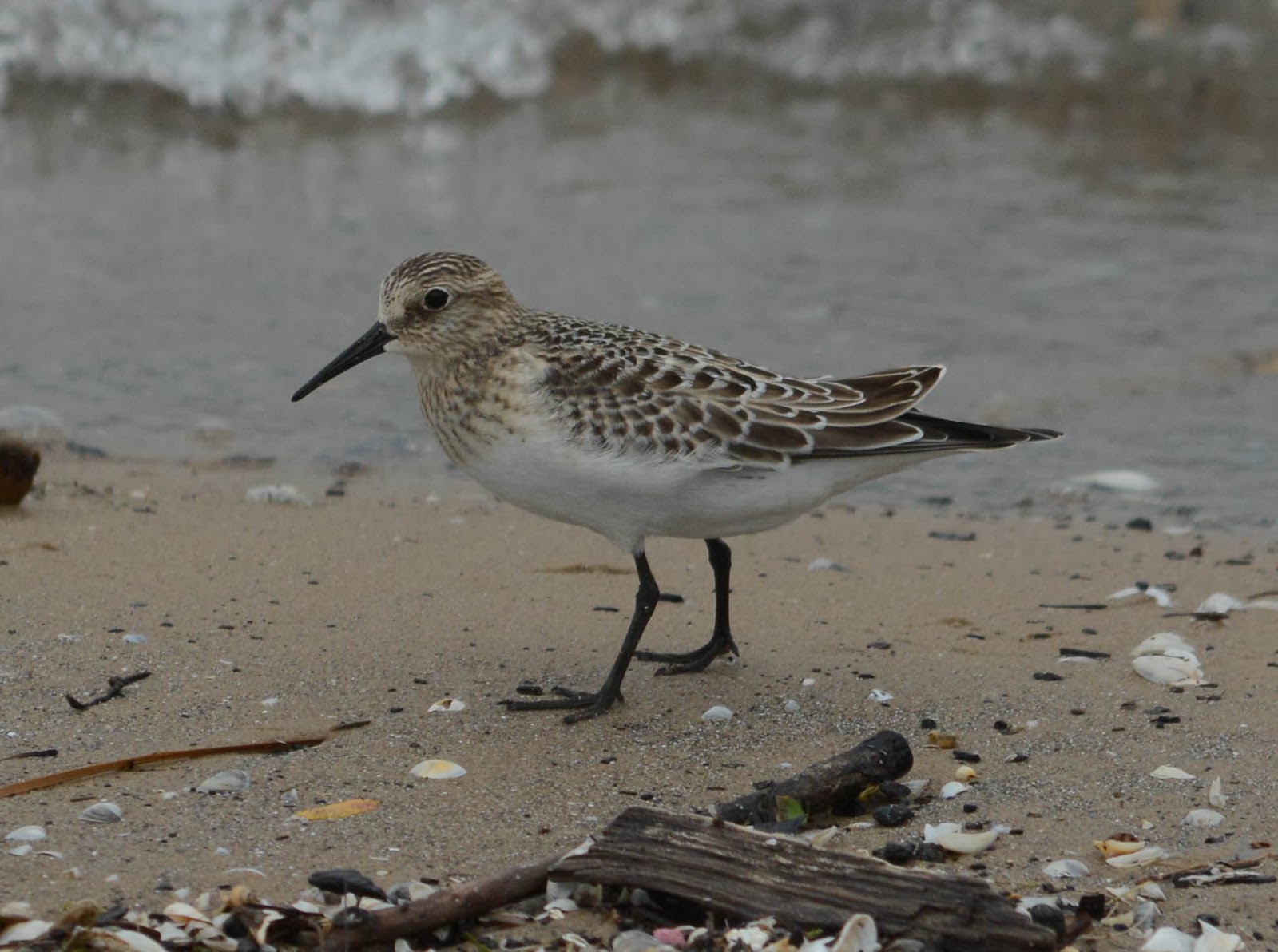
I kept trying Montrose, hoping to get a Ruddy Turnstone or Whimbrel, but it just wasn't meant to be. On a day towards the end of August I did get outstanding looks at this Baird's Sandpiper, which turned out to be one of my favorite shorebirds of the season.

Baird's Sandpiper
Montrose, Cook Co, IL
August 28, 2013

On August 30, I took off early and made the 3 hour trek to get to Chautauqua by sunrise. This was my first time birding Chautauqua in the Fall, which was a very different beast than the high water levels I encountered on my June trip. It was remarkable. And while I missed some of the rarer things that had been reported in the previous weeks, I did manage three year birds and really enjoyed the experience of having unending birds to pick through.

The following weekend was Labor Day, which found a host of birders along the lakefront. The morning at Montrose provided some shorebird excitement as two American Avocets flew by while Andrew and I were running to the beach to see a Red Knot that had just flown in. These were the best looks at a Red Knot I have ever had:

Red Knot,
Montrose, Cook Co, IL
September 2, 2013

From there we headed south to 63rd St Beach, where we were greeted by the most cooperative Buff-breasted Sandpiper anyone could ever ask for. It wasn't a year bird, but it was a nice county tick and the looks were stunning as I just sat on the beach and it strutted past within just a few feet of me. A subtle, but truly striking bird:

Buff-breasted Sandpiper
63rd St. Beach, Cook Co, IL
September 2, 2013

Buff-breasted Sandpiper
63rd St. Beach, Cook Co, IL
September 2, 2013

Another standout highlight throughout August and September was the time I got to spend with Fall-plumaged warblers. This was the first concentrated experience I had with them, and again I learned a lot. I eventually picked up my first Black-throated Blue of the year (still never saw a male though), had a gorgeous Mourning, enjoyed the subtle differences of the Blackpoll/Bay-breasted duo, and found great delight in just how cool/different a Chestnut-sided looks after leaving its breeding grounds. One of the biggest surprises of the year was the number of encounters I had with Connecticut Warblers. Most of them were fleeting glances, but one very accommodating male put on a show for us at Montrose:

Connecticut Warbler
Montrose, Cook Co, IL
September 8, 2013

I knew that if 300 was going to happen, I would need to have a very productive Fall. Despite all the great experiences I was racking up, by the time mid-September hit, the numbers just weren't there. I was hoping a weekend trip to Lake Carlyle would change that. Sabine's Gulls and two species of jaegers had been seen there recently, and I still had a few gulls I needed to pick up. Based on the reports of previous years, I figured that I could expect at least a handful of year birds.

The trip ended up following the pattern already set by Fall to that point - great birding experiences, but relatively small numbers to show for it. I only ended up adding two to my year list the whole weekend. But seriously, I have no room to complain, because as I take a look back at that trip now, I can see more clearly that it was actually packed with outstanding birds.

A stop at Emiquon on the way down yielded my first Franklin's Gull of the year, as well as a chorus of Soras and this conspicuous Least Bittern:

Least Bittern
Emiquon NWR, Fulton Co, IL
September 13, 2013

At Carlyle, a chorus of Great-horned, Barred, and Eastern Screech-owls greeted us as we neared our cabin that evening. An absurdly early Lapland Longspur was a pleasant surprise the next day. We enjoyed a couple extended periods (I almost said "stints," but that would have been misleading, ha) of sifting through a large flock of shorebirds. And while godwits insisted on continually eluding me, we did have the nice highlights of a couple inland Sanderlings, a Red-necked Phalarope, Stilt Sandpipers, Buff-breasted Sandpiper, and the best of all, a Western Sandpiper. Studying this bird at length was probably the best part of the trip for me. Slightly drooping bill, subtle rusty scapulars, larger than nearby peeps:

Western Sandpiper
Carlyle Lake, Clinton Co, IL
14 September, 2013

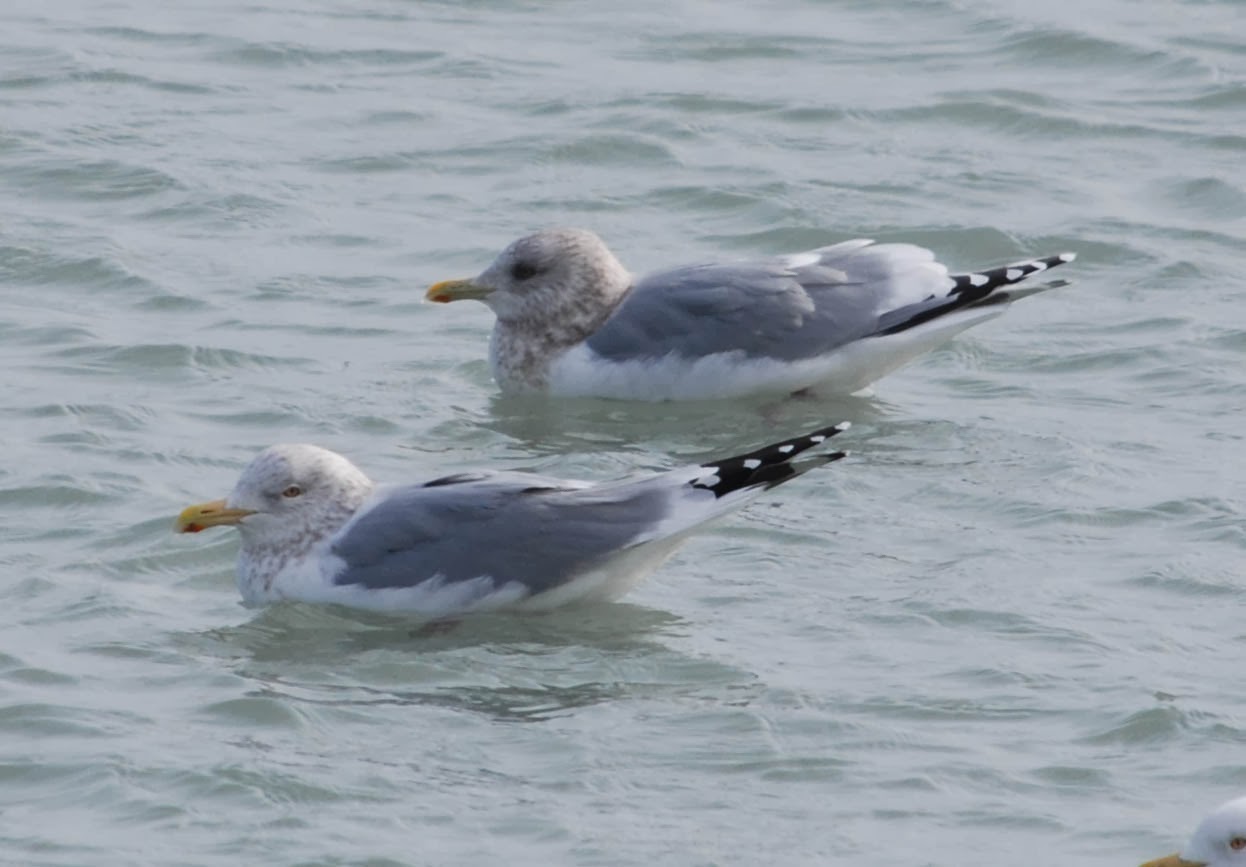
The primary purpose of this trip, planned by the Illinois Ornithological Society, is the "pe-lake-gic" trip out on to Carlyle Lake. Unfortunately, the recent rarities around the lake had all departed, and the only unique gull we found was this sharp looking second cycle Lesser Black-backed Gull:

Lesser Black-backed Gull
Carlyle Lake, Clinton Co, IL
September 14, 2013

A completely albino swallow sp. amidst the huge flocks over the lake was one of the more bizarre birds I've ever seen. One of the best treats of the boat trip was getting close looks at flocks of Forster's and Black Terns:

Black Tern
Carlyle Lake, Clinton Co, IL
September 14, 2013

We stopped by Meredosia on the way home, where a really nice mixed flock of fall migrants gave us a little momentum: Blue Grosbeak, Summer Tanager, and a lingering Prothonotary Warbler were nice additions. Then we headed back to Emiquon where we picked up a Little Blue Heron, yet our misses far outweighed our finds, leaving a bad taste in my mouth at the end of the trip. We missed a Ruddy Turnstone by 15 seconds, and later learned that a Parasitic Jaeger and a flock of plegadis sp. had been in the same area. We were just in too much of a hurry to see any of it. It was a tough ride home as the reality of 300 being out of the question sunk in (turns out May isn't the time to start thinking about such endeavors). But now, as I think back about the trip, I realize that it's important to soak in the good moments (and we had so many!) when you have them, and not let the misses get you down. This will be an important lesson for 2014 as I set my sights high.

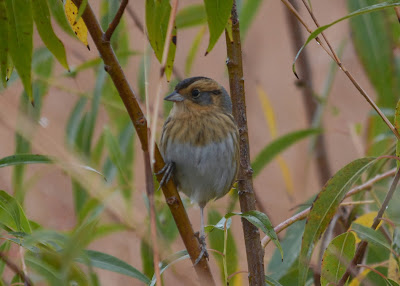
Worn out on several levels after that trip, I didn't do much birding for the next couple weeks. School was really picking up at that time too, and I was still adjusting to my new work responsibilities, so when I finally got out again in early October, it was a welcome relief. I had actually been eagerly awaiting October, and not just for Pumpkin Spice Lattes (no, I don't start drinking them in August when Starbucks begins their advertising campaigns) the Midwest's changing colors, and the reintroduction of fleeces and flannels into my wardrobe. Rather, I had one word on the mind: ammodramus. I hadn't seen either of the "orange sparrows" in Illinois before, so I was thrilled to get out and gain some experience in this area. I wound up getting great looks at Nelson's Sparrows in DuPage, Will, and Kane Counties, and a series of fleeting encounters with a LeConte's at Prairie Green in Kane.

Nelson's Sparrow
Peck Farm, Kane County, IL
October 12, 2013

Our semester took an unexpected turn towards the end of October when sharp abdominal pains landed Jen in the ER late one Saturday night. Three hours later she was going in for surgery for a perforated ulcer. The next week was spent in the hospital, and it's been a slow recovery ever since. Thankfully everything went smoothly and the outstanding team at CDH took great care of her. We also felt very blessed as our church showered us with love and meals for the following weeks, and walked with us through every step of the process. And, Jen is doing great today thankfully!

My first chance to get back out after we got back from the hospital came a couple weeks later, just a day after the Townsend's Solitaire had been found in Kane County. This is a common bird in Washington, but I was genuinely excited to get to see it as the rarity that it is here in Illinois. The wonderful news is that, as of two days ago, it's still hanging around! Many of us are hoping it can hang on till January so that we can grab it for the 2014 list!

Townsend's Solitaire
Jon Duerr Forest Preserve, Kane Co, IL
November 8, 2013

Two days later I had the treat of seeing a local Northern Saw-whet Owl. This faithful guy comes back to the same tree every single year. It was snoozing when I found it, and I had no intentions of waking it. But when I coughed, it momentarily perked up, just long enough for me to get this shot. What a great bird.

Northern Saw-whet Owl
November 10, 2013

On November 22, a Harlequin Duck at Loyola Park along the lakefront beckoned me. I got there early in the morning to discover it had gained a White-winged friend overnight. I also picked up the Eared Grebe at Montrose for the first time that day.

Harlequin Duck
Loyola Park, Cook Co, IL
November 22, 2013

Harlequin Duck and White-winged Scoter
Loyola Park, Cook Co, IL
November 22, 2013

And anything significant since then I've already catalogued on this blog. Andrew and I had a killer day on the lakefront, I stumbled upon two much-needed birds for the year, and in the wake of the Snowy Owl invasion, I made a significant contribution to the field of ornithology. I'm ending with 217 in DuPage and 287 in Illinois for the year. Unless of course that Brown-headed Nuthatch turns out to be legitimate and accessible, in which case we may be making a detour in the middle of a day of shopping tomorrow. Oh, the life of a birder.

Part III will come soon, and will include my birding adventures in my neck of the woods, the beautiful Pacific Northwest, where we'll be in just two short days!

Wednesday, December 18, 2013

2013 in Review, Part I: January-June in Illinois

Jen and I take off for Washington this Sunday, and given the busyness of finals week, work, and the necessity of seeing The Hobbit II in HFR before heading home, I think I have officially done my last birding in Illinois for the year. So, here's my attempt at capturing my experiences along the way. The number of relatively common lifers I got is evidence enough that this was the most birding I had done in Illinois yet. Some of these experiences I have already written about on the Illinois Birder's Forum, so I've provided a few links to those posts throughout this one.

In 2013, we celebrated our second wedding anniversary, I completed my first Master's degree and began a second, and continued my job at church while starting a new job in Student Development in August. Between trips to Washington and Wisconsin, by December 31 I will have spent about six weeks out of the state. I did not do much birding January-March, but I still managed to see 287 species of birds in Illinois.

The pressures of grad school kept me from birding consistently early on in the year, but I still got out a few times. While still on Christmas Break, I got to the Chicago Botanic Gardens to pick up both Common and Hoary Redpoll as a part of the huge winter finch influx last year. I spent some time trolling the backroads of Kane and DeKalb Counties, where I got to enjoy large mixed flocks of Lapland Longspurs and Snow Buntings. These were some of my first satisfactory views at Lapland Longspurs, a bird I still have not seen in Washington. I never would have imagined how common they are here in Illinois, which has definitely been a treat!

Lapland Longspur
DeKalb Co, IL
February 8, 2013

On February 16, I attended the Gull Frolic at North Point Marina for my first time. That was the first day Andrew Aldrich and I birded together (we have since seen 238 species together, not bad!). Highlights abounded that day, including my lifer Iceland Gull, as well as my best looks ever at Lesser Black-backed, Glaucous, and Thayer's Gulls. Andrew and I then headed south, where we picked up White-winged Crossbills and the long staying Varied Thrush.

Iceland Gull
North Point Marina, Lake Co, IL
16 February, 2013

 Lesser Black-back Gull

 Glaucous Gull

 Thayer's Gull (back)

 White-winged Crossbills
Lyons Woods Forest Preserve, Lake Co, IL

 Varied Thrush
Cook Co, IL

Through the rest of February, into March and April, my birding was almost exclusively in my home county, DuPage. Over that time I filled out my county list nicely and started picking up some momentum for the year. The Whalon Lake American Avocets on April 29 were a nice little boost going into May.

Hours after getting out of my last class for the semester, I went to McDowell Grove Forest Preserve where I encountered my first big warbler flock of the year, totaling 14 species and over 100 individuals, the highlight of which was a Prothonotary Warbler. You can tell by the number of exclamation points in my eBird checklist that I was pretty excited. This lit the fuse for an exciting month of birding to come.
 Prothonotary Warbler
McDowell Grove Forest Preserve, DuPage Co, IL
May 2, 2013

A return visit to McDowell the next day provided this incredible up close encounter with a Summer Tanager, which are easier to find breeding than in migration in DuPage:

Summer Tanager
McDowell Grove Forest Preserve, DuPage Co, IL
May 3, 2013

The next day, Andrew and I did the SBC for the Nelson Lake area in Kane County. After finishing our SBC area, we birded a few other Kane County locations and somehow wound up with 103 species, the third highest Kane Co Big Day. The best find of the day was a pair of Eared Grebes! One is poorly pictured here:

Eared Grebe
Nelson Lake, Kane Co, IL
May 4, 2013

And then my dad came, and we had a series of incredible days. Our first day out, Elsen's Hill was hopping with bird activity and we tallied 18 species of warblers there. Later in the day we found a 
Piping Plover at Fermi Lab, which is probably my best find for the year.

Piping Plover
FermiLab, DuPage Co, IL
May 10, 2013

That was followed shortly by probably my best photo of the year (and my first time on Explore!):

Bobolink
FermiLab, DuPage Co, IL
May 10, 2013

A few days later I crested 200 for the year as we birded Will and Grundy Counties, racking up 113 species, including 18 warblers and 14 sparrows, the best of which was this Harris's Sparrow:

Harris's Sparrow
Goose Lake Prairie, Grundy Co, IL
May 13, 2013

My dad's last day here was May 15, which found us on the lakefront on an incredible day for migration. We began at Jackson Park where we had 78 species, including 23 warbler species and an American Bittern. The highlight was this secretive Worm-eating Warbler:

Worm-eating Warbler
Jackson Park, Cook Co, IL
May 15, 2013
Montrose was alive that day as well, and after enjoying the action there, we headed up to Lake County where we got Common and Forster's Tern along the lakefront. This was one of my first chances of putting my new D7100 and its 6fps to work:

Forster's Tern
Waukegan Beach, Lake Co, IL
May 15, 2013 

The next day I dropped my dad off at the airport, sitting at 220 species for the year, and thinking that I would coast to 250 or maybe 260 by the end of the year. A quick succession of events over the next couple hours changed my outlook. I stopped by Morton Arboretum on the way home, where I picked up my first Black-billed Cuckoo and, more importantly, a gorgeous male Cerulean Warbler singing his head off:

Cerulean Warbler
Morton Arboretum, DuPage Co, IL
May 16, 2013

While soaking in this exciting find, I got an email from Sean Fitzgerald about a nice group of shorebirds at Fermi, including a White-rumped Sandpiper. I quickly scampered over there, and before I knew it, my year list had jumped up to 227. All of a sudden something clicked. Something about those seven birds made me begin to consider my potential for the year, and 280 seemed within reach. I went back home and began assembling a list of all the possibilities for the rest of the year, including rarities I was likely to miss.

I rounded out the rest of May with some birding in DuPage, Kane, and a day trip with Andrew to Hennepin-Hopper in which we bagged 94 Putnam County species - Least Bittern, Yellow-headed Blackbird, and Prairie Warbler were highlights. I saw 201 species in the month of May, and by the end of the first week of June, I was sitting at 236 on the year.

Throughout the Spring, I had been toying with the idea of a trip throughout the state, focusing on some of the southern Illinois specialities. It just so happened that Jen needed to go back to Washington a week earlier than I could because of her brother's graduation. Since my work responsibilities kept me in Wheaton, but only required that I be here on Sundays, I found myself with an entire week open for birding.

It started with a day trip to Carroll County, where I birded Lost Mound and the Mississippi Palisades for the first time. I found 95 species and my lifer Kentucky Warbler. The next morning I hit Montrose early before church and nailed Yellow-bellied Flycatcher, leaving me at 241 before heading out for my trip.

Kentucky Warbler
Mississippi Palisades, Carroll Co, IL
June 8, 2013

Starting the afternoon of June 9, I set out on a week long solo camping trip throughout the state. I logged 2,000+ miles and found 158 species. The list of highlights is too long for the scope of this post, but I catalogued most of them in these posts. Eurasian Tree Sparrow, Mississippi Kite, and Greater Prairie Chicken were my 3 lifers. All the Black-necked Stilts, Prairie, Prothonotary and Kentucky Warblers, Barred Owls, Red-headed and Pileated Woodpeckers, and southern waders were just part of what made this trip the memory of a lifetime. I am so grateful I had the opportunity. By the end, I was at 262 for the year. I figured 280 would be doable, 290 would be incredible, and 300 would be pretty much out of reach unless something crazy happened.

Eurasian Tree Sparrow
Chataqua NWR, Mason Co, IL
June 10, 2013

Mississippi Kite
Michael Wolf Wetlands, Johnson Co, IL
June 12, 2013

Greater Prairie Chicken
Karl Bartel Prairie, Marion Co, IL
June 14, 2013

Okay, I really need to go write a paper now. Check back soon for Part II!

Sunday, December 8, 2013

On Identifying Non-Snowy Owls

Perhaps you've heard already, but it's looking like Snowy Owls are invading this winter.

I say "perhaps" because it's been written about, wait for it:

herehereherehereherehereherehereherehereherehere, and here, just to name a few.

Yet for all the press, I find that something is going overlooked: the proper identification of Non-Snowy Owls (official banding code: NSOW; Latin name Nonsnowycus whitethingis). Steve Brenner gives this helpful rundown of a couple misleading objects, and this tumblr will no doubt be a crucial resource in moving forward in this field. But I want to press the issue a little further, looking at identification and taxonomic issues.

Identification - Living Non-Snowy Owls:

I assume birders to be proficient in this area, thus this section will be short. However, given the reality of frequently interacting with non-birders, this could provide a helpful refresher, and maybe even some useful fodder for conversation with friends and family over the holidays. "Hey uncle Frank, remember how you told me that you saw a Snowy Owl on your trip to Dallas last June? Well, I've been meaning to talk to you about that..." Here are some of the culprits:

  • Barn Owls - Just because an owl is white does not mean it is a Snowy Owl. You know this, but your friends don't. Be kind in the way that you break the news to them that the bird that hangs out year round in their back shed is indeed something other than a Snowy Owl.
Owl that is white? Yes.
Snowy Owl? No.

  • Gulls - Though sometimes confused with Snowy Owls, the key thing to remember is that gulls look nothing like owls. Bulky bodies. Large heads. Thick wings. These are characteristics of owls, not gulls.
A flock of gulls in flight. Notice how they look like gulls, not Snowy Owls.

  • Small white mammals - Whether it's an ermine, feral cat, or white yapper dog, it's essential to note that all of these things have four legs. Snowy Owls only have two. Also, mammals don't fly. Snowy Owls do.
  • White Phase Gyrfalcon - If you see this glorious white ghost, you're probably not hurting for Snowy Owl encounters.

Identification - Non-living Non-Snowy Owls:

The non-living Non-Snowy Owl can, surprisingly, be a little trickier. It is generally described as "a white thing, resembling a Snowy Owl, with a distinct lack of the features shared by all Snowy Owls - no feathers, no bill, no talons, no wings, no consistent migratory pattern."* The point on migratory patterns is currently debated, because the data continues to pile up and there seems to be a clear connection between the current subspecies plasticbagian (Plastic Bag; see below) and agricultural fields directly to the south of the nearest grocery store/gas station.

Since Snowy Owls show up in a wide array of habitats (from roof tops to driftwood), and since they are known to migrate to absurd locations (Bermuda? Really?), it's important that we don't restrict the Non-Snowy Owl to a specific set of behaviors or a particular range map. They can show up anywhere, by any means, and look like almost anything.

As a way of discussing some of the distinctive features of the different types of non-living Non-Snowy Owls, I'm offering the following as a proposed split for this species.

Proposed Taxonomic Breakdown:
Should Snowy Owls be categorized under the genus Bubo? David Ringer provides some helpful thoughts on this matter here. But the question I'm interested is this: will all the subspecies of NSOW continue to be lumped into one species, or will they be split? For all its well-earned hype, the ABA's outstanding Birder's Guide to Listing and Taxonomy has clearly overlooked this matter. Here are my proposed splits:
  • Nonsnowycus plasticbagian - The Plastic Bag. This is a particularly tricky one, for the Non-Snowy Plastic Bag can even move at times, giving the impression of an actual Snowy Owl. It also takes on a number of different shapes. A scope is typically needed on these when they're stuck out in a field, but if the one being blown quickly along the ground has you thinking Snowy Owl, you may consider looking into a new hobby. 

This beautiful adult male was worthy of a look in the scope for me. Note the lack of any black markings.
Nonsnowycus plasticbagian
DuPage Co, IL
December 6, 2013

Nonsnowycus stupidsignus - The Stupid Sign. A sign out in the middle of the field can be good for approximately zero things, hence the classification Stupid Sign. While some may consider this a little harsh, let's think about it for a minute. Small signs in fields can't be read by anyone. Take for instance the sign below, which is nestled up against a berm (common in all NSOW), thus not visible from the other side. It is also a couple hundred yards from where this picture was taken, from whence it is obviously not legible. Also, it is not a Snowy Owl, adding to its stupidity.

The quadrilateral nature of this Non-Snowy readily separates it from a Snowy Owl. However, it can easily be confused with the plasticbagian subspecies if it the wind sustains one in a square-like shape for a prolonged period of time (common on the Great Plains and in coastal regions).
Nonsnowycus stupidsignus
DuPage Co, IL
December 6, 2013

Nonsnowycus milkcartonus - The Milk Carton. Even the vegans and lactose intolerant stumble upon a milkcartonus here and there. These can be found in fields, cap on or off. The 2% variety can be a dead give away for this species by that royal blue sticker on the side - but only if it's still adhered, and even then can be viewed only at certain angles. Also, the handle is a great thing to look for, but again can only be discrned at certain angles. A scope is preferred for a sure ID.

Here's a look at the milkcartonus in its natural setting amongst coffee creamer, spinach artichoke dip, and leftovers. It's nice to get to study these at close range every once and a while.
Nonsnowycus milkcartonus
DuPage Co, IL
December 8, 2013

Nonsnowycus driftwoodis - Driftwood. Those in the coastal regions are likely familiar with this. While unlikely to be confused with another species of Non-Snowy, they can at times give a Snowy Owl-like impression.

The Non-Snowy Driftwood can be difficult to pick out when five actual Snowy Owls draw most of your attention. This one snuck its way in on the left side of this pic.
Notice also the rare pasty-white jogger leg in the top left corner - these do not often share the same climate as Snowy Owls.
Boundary Bay, British Columbia
December 21, 2011

Nonsnowycus sp. - If this taxonomic alteration goes through, there will be some frustrating moments when you can't assign your NSOW to a species. Lighting, angle, and distance all have a role to play here.
I had to let this one go as a spuh. The blob-ish nature of this Non-Snowy could fit a couple species, though I think milkcartonus and driftwoodis can be ruled out.

Hopefully others will soon get interested in this field as well. There's always something to learn and seemingly always a new piece of crap trying to masquerade as a true Snowy.

Lest all this nonsense confuse you too much, I'll close this post with an actual Snowy Owl from two years ago:
No, it didn't flush.
Snowy Owl
Montrose, Cook Co, IL
December 15, 2011

*Myself, 2013.

Friday, December 6, 2013

Two Great Late Additions!

Rough-legged Hawk.

Trumpeter Swan.

Birds that have evaded me thus far in Illinois, much to my chagrin. Two of my most inexcusable misses, really. I didn't do much birding in the opening months of 2013, which is part of why I missed both of them, but still. I've spent a decent amount of time targeting each, and have come up empty every time.

Before a weekend of paper writing, I decided to get out for a little while to bird some local areas on this chilly morning, neither of these birds really being on my mind. I began at Elsen's Hill to try to locate the Pileated that's been seen there on and off this fall. The preserve was pretty quiet overall, though I had 4 species of woodpeckers. But no Pileated. The mini highlights were a hardy little Yellow-rumped Warbler flitting atop a tree, and the reliable pair of Great-horned Owls, one of which is pictured here:

Great-horned Owl
Elsen's Hill, DuPage Co, IL
December 6, 2013

Pella was pretty empty, and Fermi Lab was rather slow too. Mallards were exceptionally high in number, but the only other ducks were three American Black Ducks and two Common Goldeneyes. The large flocks of Canada Geese yielded a few Cacklings, but nothing else. I'm still waiting for my DuPage Snow Goose for the year - it didn't take nearly this much effort last year!

At this point the temperature seemed to be dropping every time I got out of the car, and a little breeze was shooting right through me. Not my favorite. But I decided to keep moving west and check a few Kane County locations. The Kaneville Sod Farms had a nice flock of Horned Larks. I scoped through and picked out four Lapland Longspurs, but no Snow Buntings. The scope looks at longspurs were a welcome alternative to all the flyovers I've had recently. Even in their winter plumage, they're sharp looking birds.

I then checked a few nearby ponds loaded with waterfowl. After Mallards and Coots, Ring-necked Ducks dominated the flock. Lesser Scaup, Common Goldeneye, American Black Duck, Northern Pintail, Green-winged Teal, and a lone Canvasback rounded out the small waterfowl. I had my highest numbers of Cackling Geese this season amongst the many Canadas. I could make out some swans in the distance, so I decided to drive around to get a better view of them. That's when it got fun.

On my way to the next scoping location, a buteo crossed the road in front of me then paused to hover just outside my passenger window. As it did so, it flashed the black belly and dark wristbands of a light morph Rough-legged Hawk! I snapped off a couple quick pics and began the celebration. A long awaited bird, now conquered! Kane County life bird #172, year bird #171; Illinois life bird #288, year bird #286. The lighting was poor, but it's still worthy of a post just because of its significance for me:

Rough-legged Hawk
Kane Co, IL
December 6, 2013

But the fun was just beginning. It turned out that the couple swans I had originally seen were part of a flock of 53 birds altogether! I began picking through them - Tundra, Tundra, Tundra, Tundra... Then, 2 larger, all white birds with bright orange/pink bills - Mute Swans! Kane County life bird #173, year bird 172. And then, the most unexpected bird of the day. A large swan caught my attention next to a couple Tundras. As I compared the bill shape, and the thickness of lores between the birds, I realized I was looking at a Trumpeter Swan! Kane County life bird #174, year bird #173; Illinois life bird #289, year bird #287. I wound up with a really helpful comparison shot:

A helpful reminder that angle and positioning can have a drastic impact on our perceptions of a bird's size. The size difference between these birds was noticeable at certain points while observing them in the field, but is negligible in this photo.
Tundra Swan (left) and Trumpeter Swan (right)
Kane Co, IL
December 6, 2013

In a matter of minutes, a slow winter day transformed into an incredibly productive outing! I couldn't believe that the two birds I had specifically wanted for so long showed up at the same pond within a five minute stretch. That's really the essence of birding, and part of why I love this hobby so much. Also, the gratification of finding both of these birds on my own far outweighs any satisfaction that would have come from just tracking down someone else's find.

To add to the craziness, I wound up getting another fly by Rough-legged Hawk at Pella on my way home. DuPage life bird #224, year bird #217. I figured that once I saw my first Rough-leg I wouldn't have any difficulty seeing them again; sure enough!

Between final papers and job responsibilities at the end of the semester, I'm not sure how much I'll get out in the next couple weeks. Then we'll be heading back to Washington for two weeks with family over Christmas and New Years. All that to say, I may have found my last Illinois year birds for 2013. Having nabbed these two species, I cannot complain about ending with #287! Don't get me wrong though, I'm not hanging it up just yet.

Tuesday, December 3, 2013

Finding Joy in Quick Outings

While the day on the lakefront this last weekend was outstanding, it unfortunately is not the norm for me to get to devote an entire day to birding. A couple times per week I try to fit a few hours in here and there amidst the hustle and bustle of a given day. If you're a birder with any combination of a family, job, or life in general, this is probably the case for you too. While this rarely seems like enough time to do all the birding I'd like to, I have learned to find joy in quick outings, and have been pleasantly surprised at what all I can find in a short span. And, the way I see it, any extra check of a local patch is never truly in vain.

A quick outing from a couple weeks ago illustrates this point quite well. I still have a few odds and ends to pick up for my home county (DuPage) for this year - the easiest of which are the local wintering geese species. Fermi Lab and the Pella ponds - only 15 minutes from here - are excellent locations in the county for finding these geese. With this in mind, I made my way that direction with the hopes of adding a county tick or two for the year.

Fermi didn't produce any non-Canada Geese, which was a little disappointing. However, the stop here was still a great success, as this juvenile Red-Shouldered Hawk appeared out of nowhere - not just a county year bird (#215), but a county lifer (#223)! I have spent minimal time with Red-shoulders, so I was thrilled to get to study this bird at close range through the scope for a few minutes.

Red-shouldered Hawk
Fermi Lab, DuPage Co, IL
November 21, 2013

Quite content with this unexpected addition, I continued on to Pella as rain began to lazily pelt my windshield. After being a reliable location all Spring, Pella has been a consistent disappointment to me throughout the Fall; but that all changed upon my arrival this day. A large flock of geese foraging in a field drew my attention, and as I got the binocs on them I immediately saw a few white faces sticking out of the standard Canada crowd - a flock of 34 Greater White-fronts! DuPage #216 this year, and my second in a matter of minutes. Such handsome birds they are:


Greater White-fronted Geese,
Pella Ponds, DuPage Co, IL
November 21, 2013 

I wasn't gone for more than three hours, yet it was a wonderfully productive birding trip. Consistently birding the same spots over long periods of time truly does pay off in the long run. Get out there and bird those local patches!